
The complete guide
How to Choose Skinny Silk Scrunchies, A Practical Buyer's Guide
The small problem that keeps showing up
Most people own a bag of hair ties and quietly hate all of them. The thin ones snap. The thick ones leave a ridge across the ponytail that takes a brush and some patience to flatten. The cheap fabric ones go bobbly after a month and start grabbing strands on the way out. None of this ruins a day, but it is a tiny annoyance repeated several times a day, which adds up.
A silk scrunchie solves a specific part of that. The band that touches your hair is smooth. Hair slides over it rather than catching on a rough surface or on exposed rubber. That is the whole idea, and it is a material fact about silk rather than a promise about your hair.
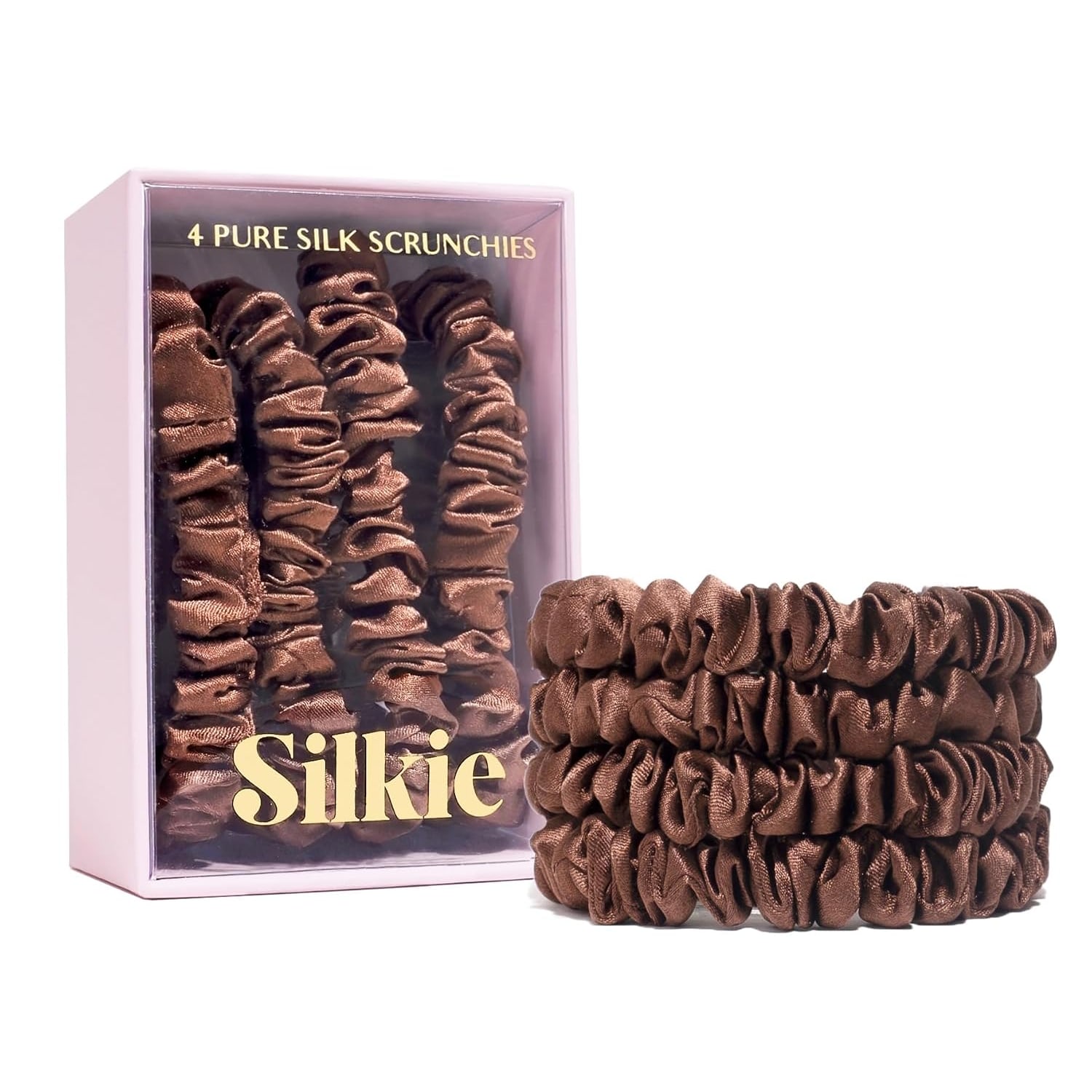
This set is the skinny version. Four scrunchies, praline tones, and a pouch to keep them in.
How a scrunchie actually works
Inside every scrunchie is an elastic loop. Around it is a tube of fabric, gathered so there is more fabric than elastic. When you stretch the loop, the gathers open and the fabric takes the strain instead of the rubber. When you let go, it bunches back up.
That gathering is what makes a scrunchie kinder than a bare elastic. A plain elastic has a hard edge, and all the pressure lands on a narrow line of hair. A scrunchie spreads the same hold over a wider, softer band, so there is no single point digging in.
Silk adds the second part. It has a low-friction surface compared with cotton or a woven synthetic. Take a silk scrunchie out of a bun and it tends to slide free instead of dragging. Take a textured elastic out and you often hear that small tearing sound that nobody enjoys.
Skinny versus oversized is about look and placement more than function. Both hold. The slim one sits flatter, tucks under a cap or a helmet strap, and does not add visual bulk to a neat updo.
Who this set suits
If you wear your hair up most days and want the tie to be a background detail, the skinny profile makes sense. It gives you hold without a big fabric bow at the back of your head.
It suits fine hair particularly well. A fine ponytail swallowed by an oversized scrunchie just looks odd, and the slim band keeps the proportions right. Fine hair is also the type most likely to snag, so a smooth face helps.
Thick hair works too, with one adjustment. You may need an extra wrap. A skinny band stretches further rather than holding more bulk in one turn, so two or three turns does the job where a wide scrunchie might do it in two. People with very heavy hair often keep a wide style for a high ponytail and a skinny one for a bun or a loose overnight plait.
The low-friction surface makes the band easier to slide off curly and coily hair. A smooth band does not comb through the curl pattern on the way out.
And if you keep a tie on your wrist, which most of us do, a slim silk band looks a lot more deliberate than a stretched-out elastic.
Why four, and why neutral
A single scrunchie gets worn every day, washed rarely, and dies early. Four means rotation. Each one gets a rest, the elastic recovers, and you always have a clean one when the rest are in the wash.
Praline is a warm neutral range. The four pieces are coordinating tones, not four identical copies, which gives you some choice each morning. Neutrals get worn more than bright colours for one boring reason. They go with everything. An office outfit, a dinner, a gym session, a weekend. You never have to think about whether the tie clashes.
If you prefer the tie to vanish, pick the tone closest to your own hair colour. If you like the scrunchie to read as a small accessory, go one shade lighter or darker.
What to check when buying silk hair ties
A few things are worth looking at on any listing, including this one.
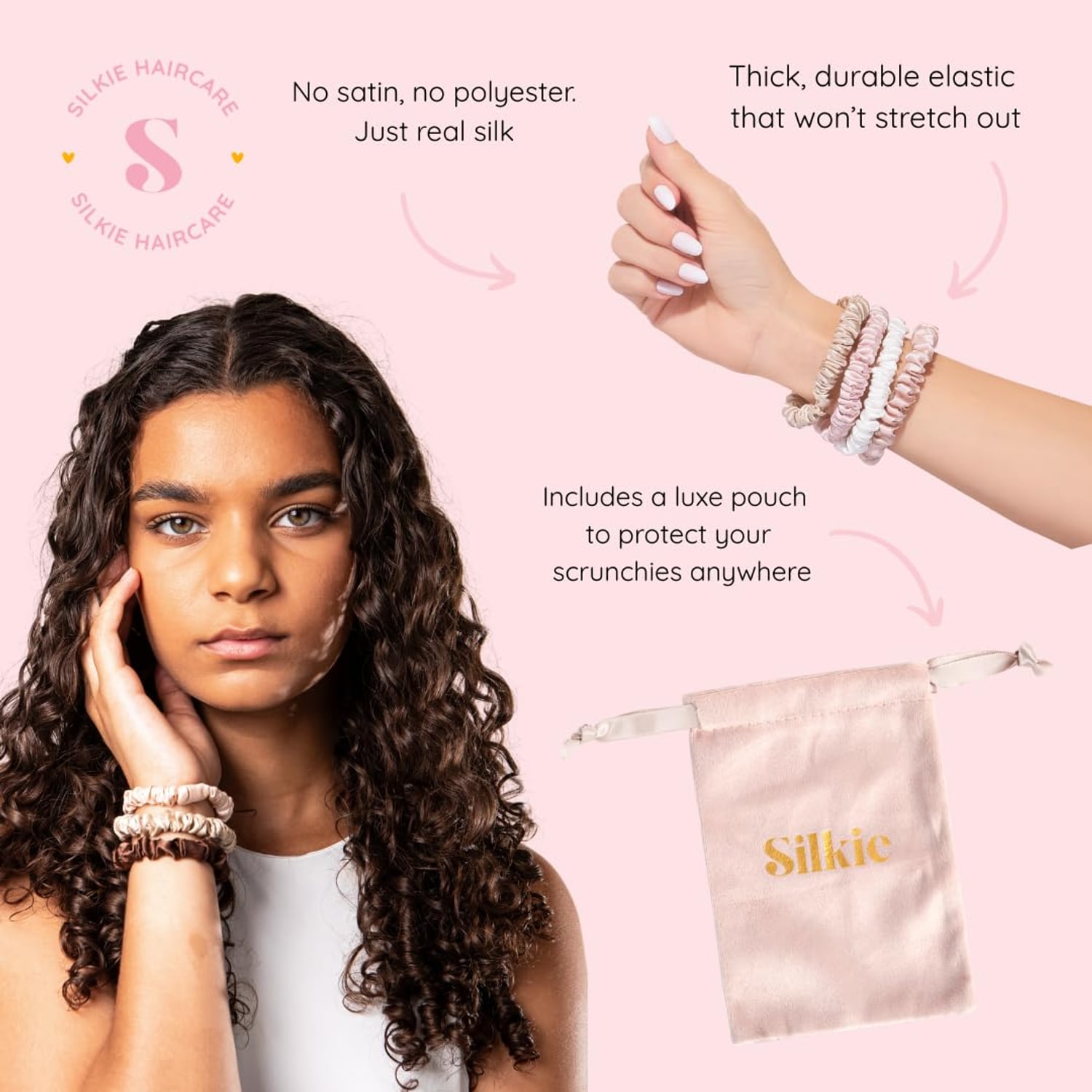
Silk content is the first. Mulberry silk is the standard description for the long-fibre silk used in bedding and accessories. Watch for wording like "silky" or "satin", which usually means polyester with a shiny face. That is not the same fibre, though it can still look good.
Momme weight tells you how heavy the silk is. Heavier silk feels more substantial and tends to last longer. The maker does not state a momme weight for this set, so judge it as a smooth lightweight silk rather than a heavy structured one.
Construction matters more than people expect. The seam should be enclosed inside the tube, and the elastic should be fully covered. An exposed elastic edge defeats the point of buying silk in the first place.
Elastic strength is the last one, and it is personal. Some people want a firm grip for running. Others want something gentle they can sleep in. If you fall in the second group, a soft covered elastic and an extra wrap is the combination that works.
Looking after them
Silk is not fragile, but it does want slightly different treatment from a cotton tie.
Hand wash in cool water with a mild detergent made for delicates. Swirl, do not scrub. Rinse until the water runs clear. Press the water out gently, roll the scrunchie in a towel, then lay it flat to dry away from radiators and direct sun. Heat and strong light are what fade and weaken silk over time.
Skip bleach, skip fabric softener, and skip the tumble dryer. If a crease bothers you, a cool iron with a cloth over the silk sorts it out, or a quick pass with steam from a distance.
Wash every week or two with daily wear, sooner if you use oils or heavy styling products. The oil is what makes a band look dull and limp long before the fabric actually wears out.
Store them in the pouch. Loose in a handbag, silk picks up lint and catches on zips, keys and jewellery. The pouch takes two seconds and genuinely extends the life of the set.
Styling ideas that work with a slim band
A high ponytail with the scrunchie wrapped so the gathers face outward looks intentional rather than accidental. Pull a small section of hair over the tie and tuck it under if you want to hide it completely.
For a bun, twist the length first, coil it, then wrap the scrunchie twice and tuck the ends under the band. The slim profile means the finished bun sits flat enough to lean back against a headrest.
Half-up styles are where skinny scrunchies really earn their place. A wide one dominates the back of the head. A slim one just holds the section and lets the hairstyle speak.
For sleeping, a loose high bun or a soft plait held at the end keeps hair contained without pressure on the scalp.
The short version
Four skinny mulberry silk scrunchies in warm praline tones, with a matching pouch. The slim gathered band holds a ponytail, a bun or a half-up style without the bite of a bare elastic, and the smooth silk face means less catching when you take it out.
Rotate the four, hand wash them in cool water, dry them flat, and keep them in the pouch. They are a small upgrade to a thing you use several times a day, which is usually the kind of upgrade worth making.