
The complete guide
How To Choose A Silk Sleep Cap That Actually Stays On
The problem with cotton at night
Most people do not think much about what their hair touches for eight hours. Then they wake up with one side flattened, the back knotted, and the front frizzed into something that needs ten minutes of fixing before they leave the house.
Cotton is the usual culprit. It is a thirsty fibre and the surface, under a microscope, is not smooth at all. Hair catches on it and drags across it every time you roll over. Multiply that by a few hundred small movements a night and you get tangles, roughed-up ends and the morning flatten.
Silk behaves differently. The fibre is long and even, and the woven surface has far less grip. Hair slides over it instead of catching. That is the whole idea behind a sleep cap: put a smooth surface between your hair and everything else, and keep it there until morning.
What a sleep cap actually does
A cap does two jobs. First, it covers the hair so your pillowcase stops being a factor at all. Second, it contains the hair, which stops it from being pulled in four directions as you move.
That second part is the one people underestimate. If you have a style you want to keep for more than one day, a set of curls, braids, twists, a blow-dry, containment is what preserves it. Loose hair spread across a pillow gets reshaped by whatever position you sleep in. Gathered hair inside a cap mostly keeps the shape you gave it.
A cap also means whatever you put in your hair stays in your hair rather than on your bedding. Overnight oils, leave-in creams and treatments all work better when they are not being blotted into a pillowcase.
Why momme is the number to look at
Silk gets sold on a lot of vague adjectives. The one measurement that tells you something concrete is momme.
Momme is a weight measure. It describes how much a fixed area of the fabric weighs, so a higher number means a denser weave with more silk in it. Most silk sleepwear and bedding lands somewhere between 16 and 25.
Lighter silks around 16 momme feel airy and cost less. They are pleasant, but they are thinner, and over months of washing they tend to show wear at the seams and edges first. Heavier silks have more body. They drape rather than float, and they stand up to regular washing better.
This cap is 22 momme. That puts it near the top of the practical range for something you wear every night. You notice it when you pick it up. It has a weight to it, not a papery feel, and it holds its shape over the crown rather than collapsing flat.
Single layer, lined, and genuinely double layer
Here is where a lot of shoppers get caught out. Three things get sold under similar names.
A single layer cap is one thickness of fabric. Fine, but thin, and the hair can press through against the pillow.
A "silk lined" cap often means a polyester or satin outer with a silk inner, or sometimes the other way round, which is worse. If the silk is on the outside and a synthetic lining faces your hair, you are paying for silk and sleeping on polyester.
A genuinely double layer silk cap, like this one, is silk on both faces. The outside is 100% mulberry silk and the inside is 100% mulberry silk. That gives you the smooth surface where it matters and a bit of structure from the second layer, so the cap sits properly over the head instead of clinging to it.
If you are comparing options and trying to find the best double layer silk cap, the question to ask about any listing is simple: what is the inner layer made of? If the answer is unclear, assume it is not silk.
The closure matters more than you think
Most caps use elastic. Elastic is cheap and it works, right up until it does not. Heat, washing and stretching all take their toll, and a loose cap is a useless cap. You wake up and it is on the floor.
Elastic also has a second problem. A band tight enough to hold reliably can press into the hairline, and that pressure across the same line night after night is not comfortable.
This cap uses an adjustable buckle at the band instead. You open it out, put it on, and pull it to the tension you want. If your hair volume changes, if you move between styles, if you want it looser in summer, you adjust it. That is the main reason an adjustable silk sleep cap tends to outlast a fixed-elastic one.
It also makes sizing much less of a gamble. Caps with fixed bands either fit or they do not. A buckle gives you a range.
Who this suits
Anyone who wakes up with more tangles than they went to bed with is a candidate. Beyond that, a few groups get the most out of it.
People with curls and coils often already know about silk at night, and a roomy double layer cap gives curls somewhere to sit without being crushed.
People with long hair get the containment benefit, as long as they coil the length properly before tucking it in rather than just stuffing it under the band.
People who spend money on treatments, colour or a blow-dry want that work to survive the night, and a cap is the cheapest way to extend it.
And people who travel like it because it weighs nothing, folds into any corner of a bag, and works the same in a hotel as it does at home regardless of what the bedding is made of.
Getting the fit right
Put the cap on over dry hair. Gather the length and coil it loosely at the crown or the nape, whichever sits more comfortably when you lie down. Pull the cap over, then tuck in any stray sections at the front and around the ears.
Set the buckle so the band holds without pressing. You should be able to slide a finger under it. If you can feel a line on your forehead in the morning, it was too tight.
One habit worth building: check the fit after you lie down, not just while standing at the mirror. Heads change shape against a pillow and a band that felt right standing up can shift.
Washing and keeping it good
The cap is machine washable, which saves a lot of bother. Use a cool, gentle cycle, a mild detergent made for delicates, and a mesh laundry bag. The bag matters mostly because of the buckle, which can catch on other items in the drum.
Leave out the bleach and the fabric softener. Softener coats the fibres and takes the slip out of the silk, which is the opposite of what you want.
Reshape the cap while it is damp, then lay it flat to dry away from radiators and direct sun. Heat is hard on silk over time. If a crease bothers you, the lowest iron setting with a cloth over the silk sorts it out.
Washing every week or two is enough for most people. If you use heavy oils or creams overnight, go more often, since product build-up dulls the surface and the whole point is the slip.
What you are actually buying
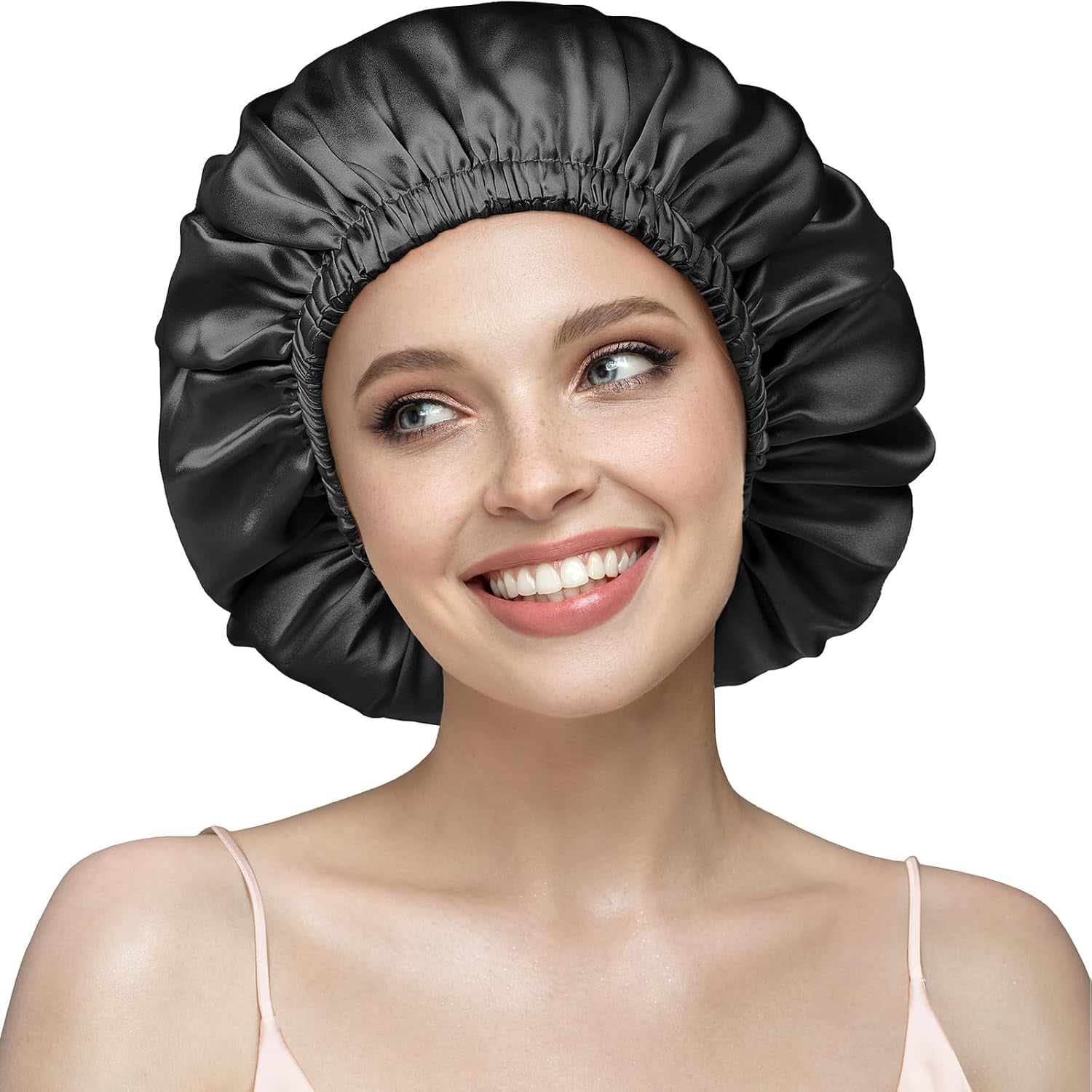
A plain black cap in 22 momme mulberry silk, silk on both layers, with a buckle at the band instead of elastic, and machine washable care. That is the complete picture.
Black is the sensible colour for something that lives on a bedside table and gets packed into bags. It does not clash with anything and it does not show every mark the way ivory does.
Brand, country of origin, finished dimensions and weight are not specified, so we are not going to guess at them.
The short version
If you want hair that stays where you left it overnight, a silk cap is the simplest fix available. Look at the momme number, because it tells you more than any adjective on the page, and 22 is a solid, durable weight. Check that both layers are silk, not just the outer one. And choose a buckle over elastic if you want the fit to still be right in a year.
This cap ticks those three. Plain black, double layer mulberry silk, adjustable band, and a gentle machine wash when it needs it.