
The complete guide
How to Choose Silk Scrunchies That You Will Actually Wear Every Day
The small annoyance nobody talks about
Hair ties are one of those things you buy without thinking and then use three times a day. You tie your hair up to cook, to work out, to get through a video call, to sleep. Over a week that is dozens of small moments of pulling a band on and off.
The annoyance shows up at the end of the day. A thin rubber band grips hard and has to be worked loose. A cotton-covered band has a slight texture that catches on individual strands. Neither is a disaster, but both are a small daily friction that you stop noticing because you assume that is just how hair ties work.
It is not. The fabric on the outside of the band makes a real difference to how easily it comes out. That is the whole reason silk hair ties exist as a category.
What silk actually does here
Silk is a long, continuous filament rather than a short staple fibre spun together. Woven up, it has a flat, smooth surface. Cotton, by comparison, has a slightly fuzzy surface made of thousands of short fibre ends.
Run your hand over both and you can feel it. Hair feels it too. Strands slide across the smooth surface instead of gripping it, so the band slips out with less tugging.
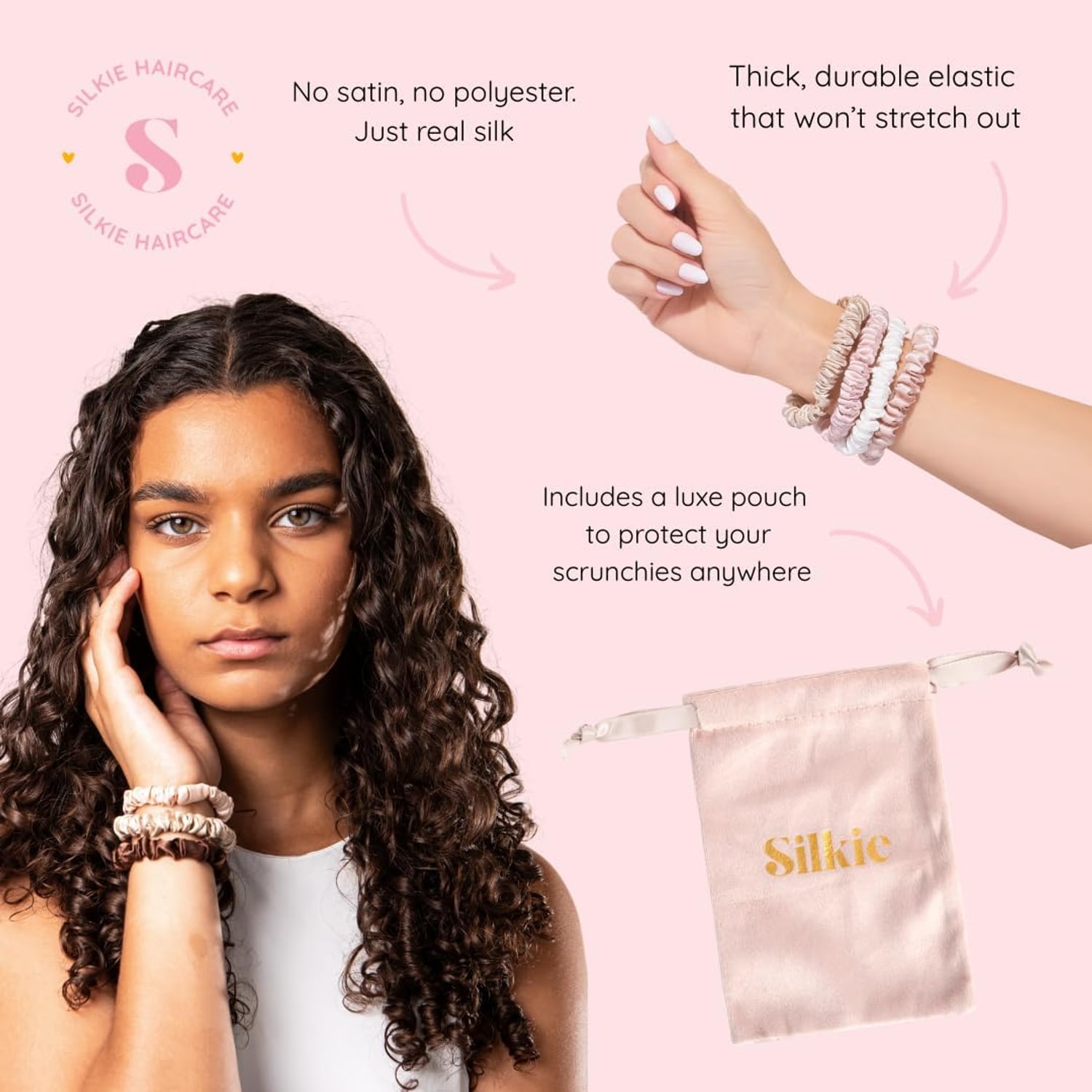
These scrunchies use 100% mulberry silk for the outer fabric. Mulberry silk is the variety produced by silkworms fed on mulberry leaves, and it is prized because the filament it makes is long and even. The elastic that provides the stretch is enclosed inside, so your hair never touches it directly.
That is the honest description of what you are buying. It is a smoother surface wrapped around an ordinary elastic core. It is not a treatment and it does not do anything to your hair beyond that.
Skinny versus chunky
Scrunchies come in two broad shapes, and they behave quite differently.
The chunky style has a lot of fabric gathered along the band. It looks soft and decorative, it holds a thick bun comfortably, and it is clearly visible. If you want the tie to be part of the outfit, that is the one.
The skinny style, which is what this set is, has much less fabric. It sits close to the hair rather than standing out from it. The result is tidier. A low ponytail with a skinny band looks deliberate rather than casual, and the band slides under a shirt collar, a hat or a coat hood without bunching.
There is a trade-off. Less fabric means less padding, so with very thick hair you will want to wrap the band two or three times rather than once. That is not a problem, it is just how you use it. Many people with a lot of hair actually prefer the skinny style for exactly this reason, because the number of wraps gives them fine control over the tension.
Picking from four neutrals
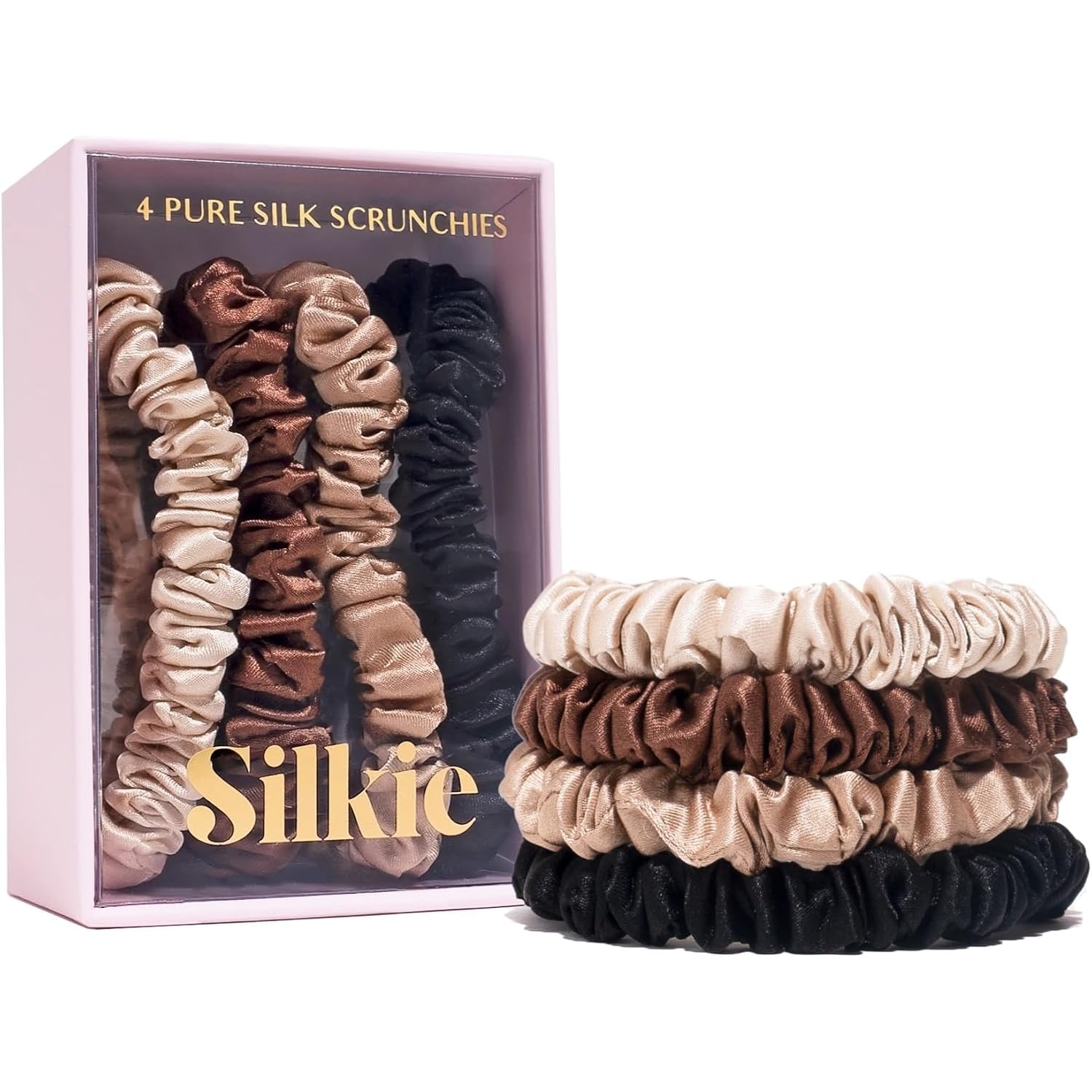
The set is beige, brown, taupe and black. That is a deliberate choice rather than a random assortment, and it is worth thinking about which one you will wear most.
Black is the default for dark hair and for anything smart. It reads as neutral with almost every outfit and disappears into dark hair completely.
Brown and taupe sit in the middle. Brown works well with chestnut and dark blonde hair. Taupe is the greyer of the two and blends nicely with ash blonde, light brown and hair that is going grey.
Beige is the lightest. On blonde hair it almost vanishes, and on dark hair it becomes a soft contrast rather than a bright one.
Having all four means you are not stuck matching a single colour to every outfit. If you are buying as a gift and you do not know the recipient's hair colour, a neutral set like this is a safer bet than a patterned one.
Who this set suits
It suits people who tie their hair up often and want the band to be unobtrusive. Office wear, evening wear, anything where a bright or oversized scrunchie would look out of place.
It suits people with fine or medium hair particularly well, because a skinny band can be pulled to exactly the tension you need. Fine hair slides out of chunky scrunchies, and this shape grips better.
It suits travellers, because four bands and a pouch take up almost no room in a bag.
It is less of a match if you specifically want the big, visible, soft scrunchie look, or if you need a single tie that will hold very thick hair in one loop. Neither of those is a fault with the product, they are just different jobs.
Getting the hold right
Most people over-tighten hair ties out of habit, because thin rubber bands need it. A silk band does not.
Start with one loop for a loose low ponytail. Add a second wrap if it slips. For a bun, go to two or three wraps around the base. If you find yourself pulling hard to get one more wrap on, stop at the previous one, because that extra tension is what causes headaches and creases.
Position matters as well. A tie sitting low on the neck puts far less strain on the hair than one pulled high and tight. If you wear your hair up all day, moving the position slightly from one day to the next is a sensible habit.
Looking after them
Silk is not fragile, but it does not like three things: heat, harsh detergent and rough handling.
Wash by hand in cool water with a mild detergent made for delicates. Swish, do not scrub. Rinse, then press the water out between the palms of your hands or in a towel. Never wring a silk band, because twisting is what breaks fibres and distorts the elastic inside.
Dry flat at room temperature, away from a radiator and out of direct sun. They dry quickly, usually within a few hours.
Keep them out of the tumble dryer. Heat is hard on silk and harder on elastic, and a dryer will shorten the life of any hair tie regardless of what it is made from.
Skip bleach and skip fabric softener. Wash dark colours separately the first couple of times.
Store them in the pouch that comes with the set. That is the simplest way to stop them snagging on zips, keys and hair clips in the bottom of a bag.
Making the set last
Rotate. If you wear the same band every day, that one band takes all the wear while the other three sit unused. Using all four in turn means the elastic in each one gets a rest and the set stays usable far longer.
Watch for the signs of a tired band. If it no longer springs back after being stretched, the elastic has relaxed and the band will keep slipping. That is normal wear, and it happens to every hair tie eventually.
Avoid pulling a band off over a wet, tangled head of hair. Comb through first. That single habit prevents most of the snagging and fibre pulls that shorten a scrunchie's life.
The short version
Four skinny scrunchies, 100% mulberry silk on the outside, elastic on the inside, in beige, brown, taupe and black, with a pouch to keep them in.
The silk gives you a smooth surface so hair slides off the band rather than catching on it. The skinny shape keeps the tie discreet and lets you control tension by the number of wraps. The neutral colours mean one of the four will go with whatever you are wearing.
Hand wash cool, dry flat, rotate between all four, and keep them in the pouch. Do that and a set like this stays in daily use for a long time.