
The complete guide
The Honest Buyer's Guide to Silk Bonnets
The problem nobody warns you about
You can spend twenty minutes on your hair at night and undo all of it in your sleep. It happens quietly. You turn over, the cotton pillowcase grips a section of hair, and it drags. Do that forty or fifty times in a night, every night, and the result is predictable. Rough ends, frizz at the crown, and curls that have lost their shape by breakfast.
Cotton is a short-staple fibre with a lot of surface texture. Under a microscope it looks like a field of tiny hooks. That texture is great for a towel and bad for hair. Silk is the opposite. It is a long continuous filament with a smooth surface, which is why hair and skin slide across it instead of catching.
A silk bonnet puts that smooth surface between your hair and everything else. Not just the pillow, but the mattress, the duvet, and the headboard you end up pressed against at four in the morning.
What 22 momme actually tells you
Momme, written mm, is the weight measure for silk. It describes how much a set area of the fabric weighs, which in practice tells you how dense and substantial it is. Lower momme silks, say 12 or 16, feel light and almost sheer. Higher momme silks feel more like fabric and less like a scarf.
At 22 momme you are in the range most people consider the sweet spot for bedding and hair accessories. There is enough weight for the fabric to sit properly and hold its shape, and enough density that it survives regular washing without going limp. It also feels nicer in the hand, which sounds like a small thing until you compare a 22 momme bonnet with a thin one.
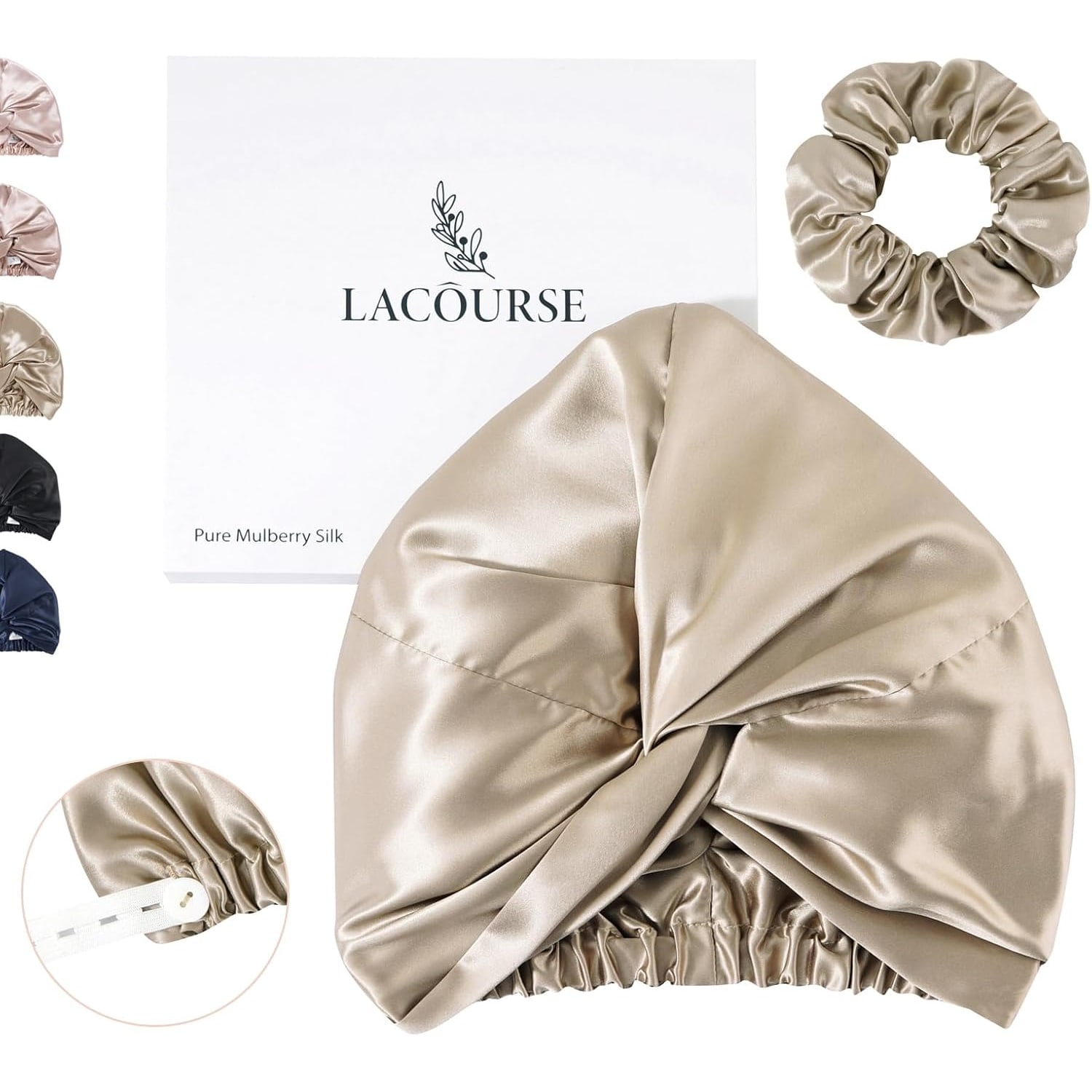
This bonnet goes further by using two layers of that 22 momme silk rather than one. That matters for a reason a lot of shoppers miss. Plenty of bonnets on the market have a pretty silk outer and a cheaper lining tucked inside where you cannot see it. The lining is the part touching your hair. Here, both layers are mulberry silk, so what you see is what your hair gets.
Mulberry silk, briefly
Mulberry silk comes from silkworms fed exclusively on mulberry leaves, raised in controlled conditions. The result is a long, uniform, pale filament. Because the fibres are long and even, the woven fabric is smoother and more consistent than silk made from mixed or wild sources.
That consistency is the practical point. A smoother, more even weave means fewer rough spots, and fewer rough spots means less friction over the course of a night.
Who a bonnet suits
The best silk bonnet for one person is useless for another, and it mostly comes down to hair volume.
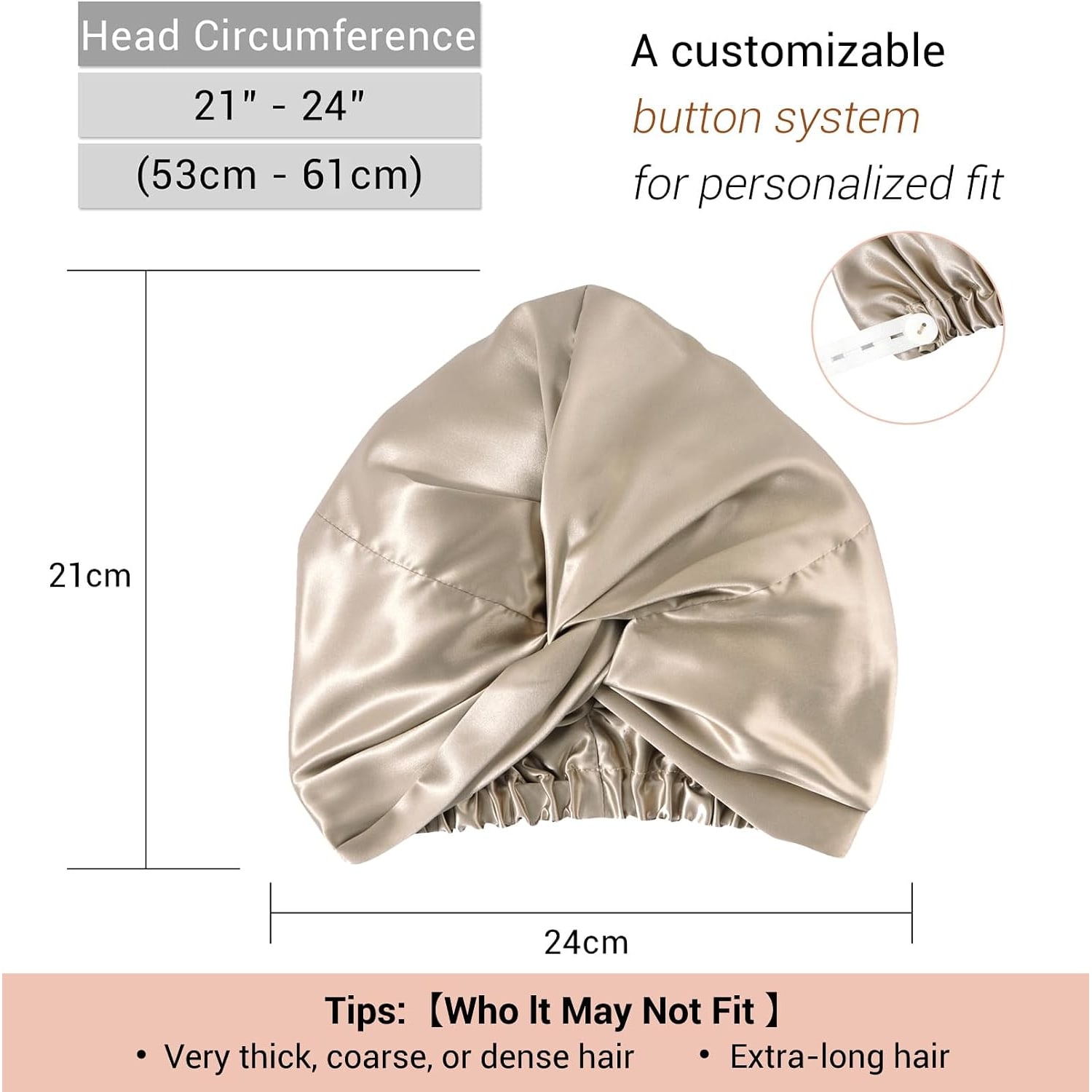
This one is described by the maker as suitable for short to long hair, including curls and waves. It is not recommended for very thick or very voluminous hair. That is a useful bit of honesty. A bonnet that cannot contain your hair either sits awkwardly on top of it or works its way off during the night, and neither outcome helps.
So before you order, do a quick check. Gather your hair the way you normally would before bed and see how much space it takes up. If it compresses down to a manageable bundle you can tuck into a crown of around 26 x 24 cm (10.2 x 9.4 in) laid flat, you are fine. If your hair resists being contained at all, look at a larger slouchy style instead.
Length on its own is less of a barrier than volume. Long but fine hair tucks away easily. Shoulder-length but very dense hair can be a tighter fit than you expect.
Why the adjustable closure matters
This is the part that decides whether you actually keep wearing a bonnet or whether it ends up in a drawer.
A fixed elastic band is a gamble. Too loose and the bonnet migrates off your head somewhere in the small hours, which defeats the whole point. Too tight and you get a pressure line across your forehead and a headache you blame on something else.
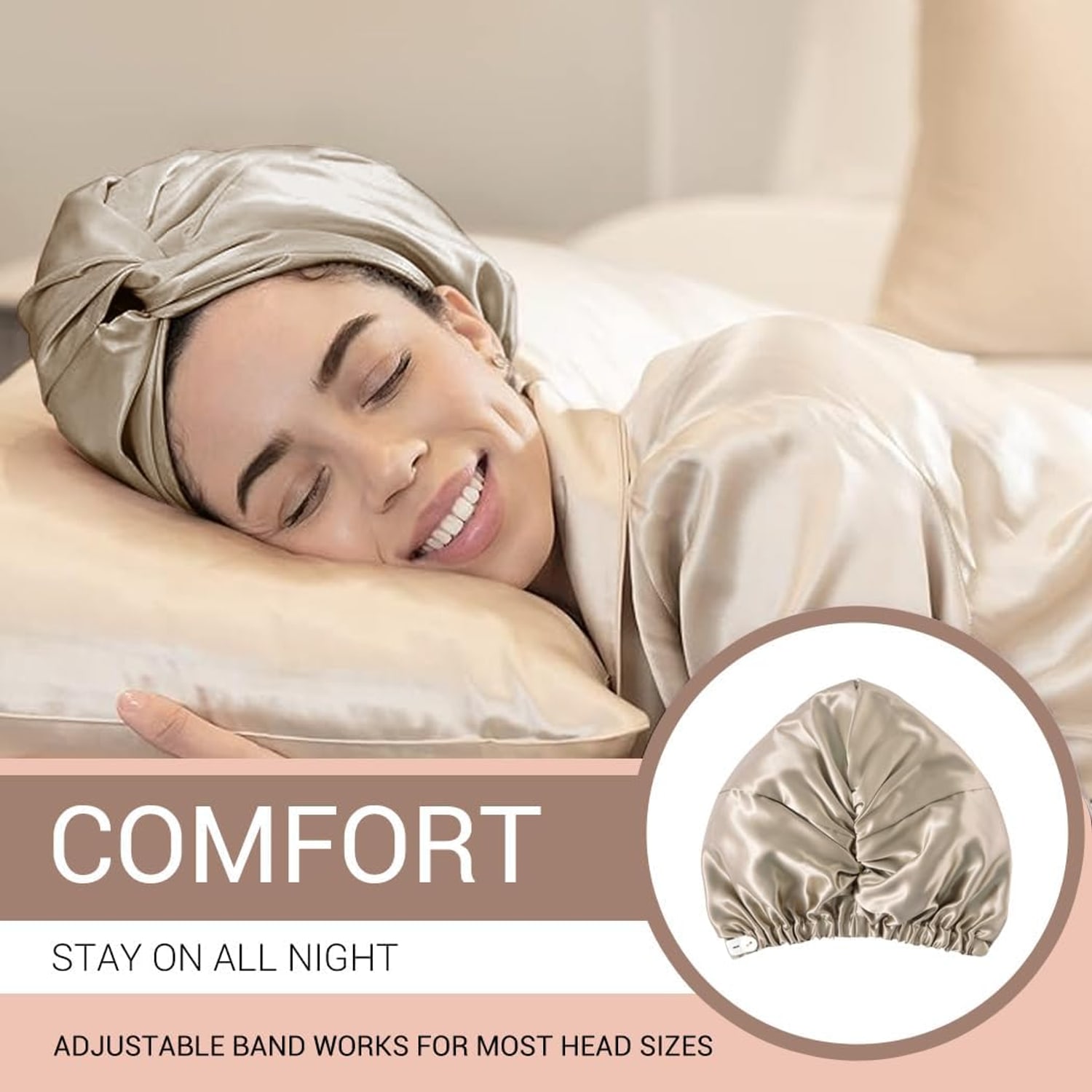
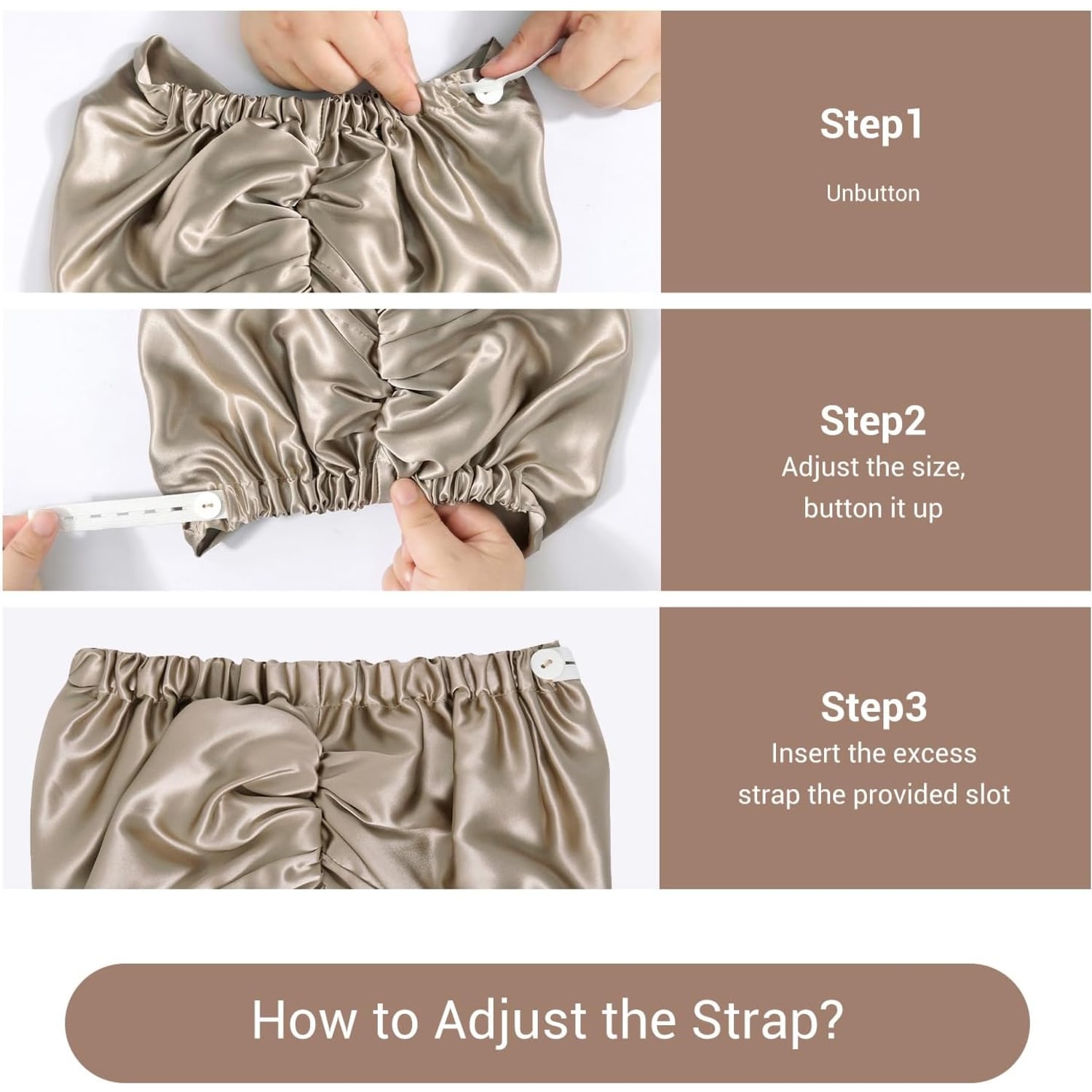
An adjustable closure lets you find the middle. Start looser than you think you need, lie down, move your head around a bit, then tighten in small steps until it holds without pressing. Once you find your setting, it stays. Most people land on it within two or three nights.
Getting the most out of the scrunchie
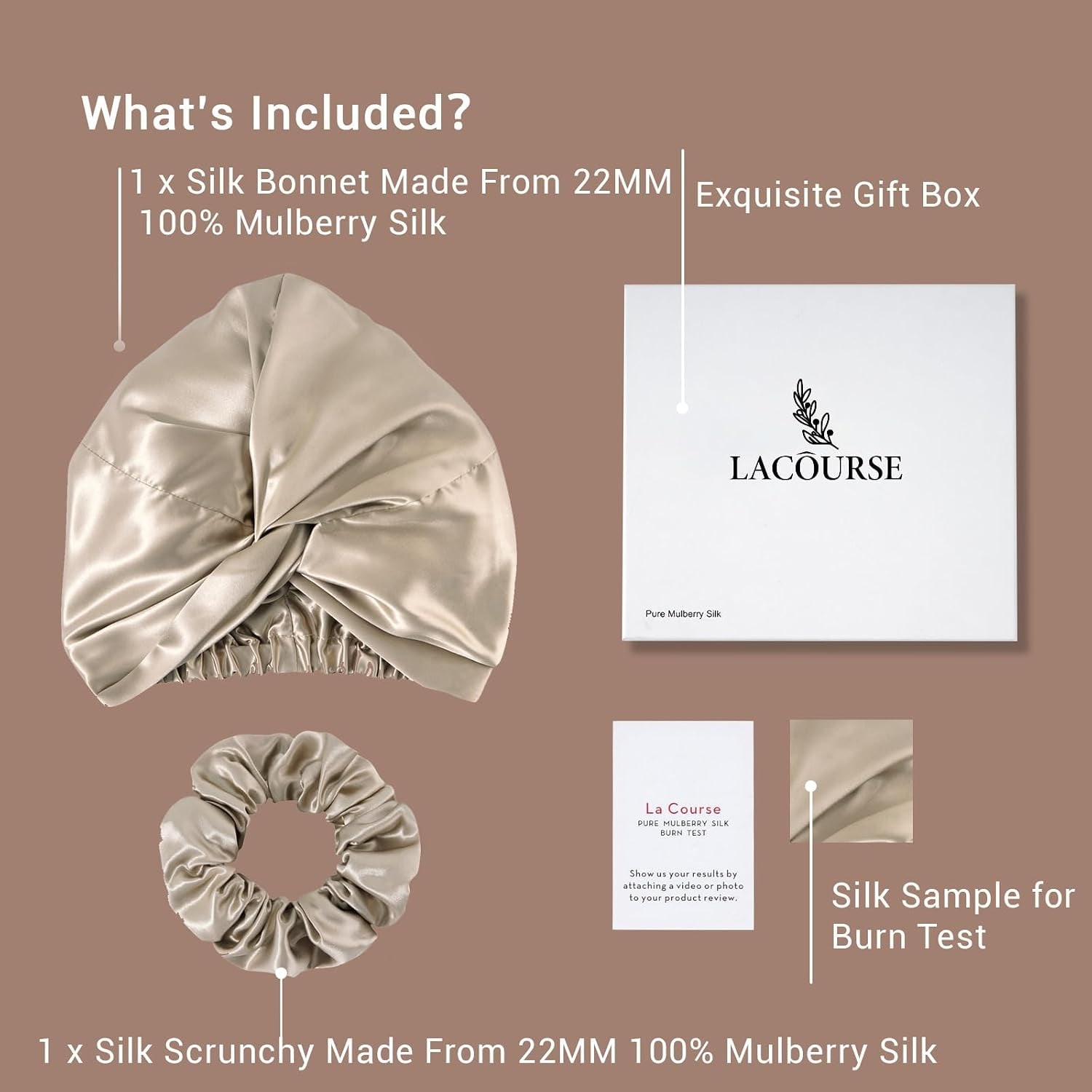
The matching silk scrunchie is not just a nice extra. It changes how the bonnet works for longer hair.
The usual mistake is stuffing loose long hair up into a bonnet in one go. It bunches, it creases, and it works its way loose. Instead, gather the hair into a loose pineapple at the crown, secure it gently with the silk scrunchie, then bring the bonnet over the top. The hair sits upright and contained, and the bonnet has something to hold onto.
Silk scrunchies also grip hair differently to standard elastics. The fabric spreads the tension over a wider surface rather than pinching a narrow band, which is why many people switch to them for daytime ties too.
Caring for it so it lasts
Silk is easier to look after than its reputation suggests. You just have to respect two things, heat and harsh detergent.
Wash in cool water, either by hand or on a cold gentle machine cycle with the bonnet inside a mesh laundry bag. Use a mild detergent made for delicates. Skip bleach entirely, and skip fabric softener too, since it coats the fibre and dulls the surface you bought the thing for.
Never wring it. Press the water out inside a rolled towel, reshape the bonnet with your hands, and lay it flat to dry somewhere out of direct sun and away from radiators. It dries fast.
Wash every week or two under normal use. If you use hair oils or rich leave-in creams, wash more often. Oil sitting in silk over time builds up and leaves the caramel colour looking patchy.
If it needs pressing, use the lowest iron setting with a cloth between the iron and the fabric. Honestly, a reshape while damp usually handles it.
A few things to be realistic about
A silk bonnet reduces friction. That is the mechanical fact, and it is a genuinely useful one. It is not a styling tool, and it will not do anything for you if you put it on and then sleep face down pressing it into the mattress all night.
It also will not survive careless laundry. Thrown in with towels on a hot wash and tumble dried, any silk will come out sad. Treat it like the natural fibre it is and it will keep working for a long time.
And one small practical note. A caramel bonnet shows oil marks more readily than a very dark one would. That is not a flaw, just something to plan your wash routine around.
The short version
Two layers of 22 momme, 100% mulberry silk, in a warm caramel colour, with an adjustable fit and a matching silk scrunchie included. One size, around 26 x 24 cm (10.2 x 9.4 in) flat. Suited to short through long hair, curls and waves, and not the right choice if your hair is very thick or very voluminous.
If you have been waking up to tangles and a flattened crown, this is the straightforward fix. Set the adjustment properly on the first night, use the scrunchie if you have length to manage, wash it cool and dry it flat. That is the whole routine.