
The complete guide
How to Choose Silk Scrunchies, A Practical Buyer's Guide
The problem with ordinary hair ties
Most of us have a drawer full of hair ties that do the job badly. Thin elastics dig in. Woven bands with a metal crimp catch on the way out. Cotton-covered ties grip so hard that taking one out feels like a small event. And if you have ever pulled a tie out at the end of a long day and found a permanent ridge across your ponytail, you know the feeling.
None of that is a disaster. It is just low-level annoyance that repeats every single day, which is the kind of problem worth spending a small amount of money to fix.
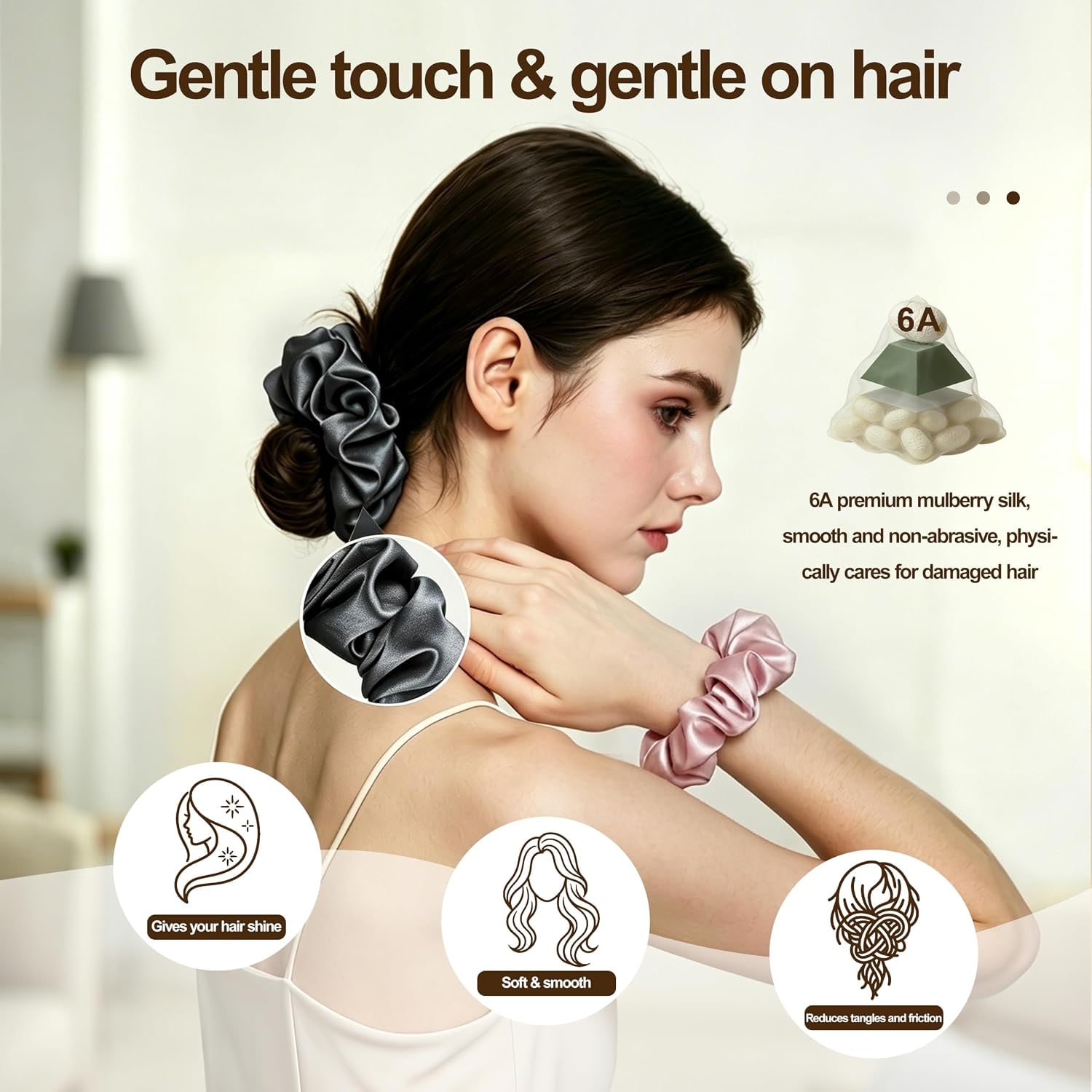
A silk scrunchie approaches it differently. Instead of gripping the hair with a textured surface, it wraps the hair in a smooth one. Hair slides over silk with less friction than it does over cotton or a bare rubber band. The elastic is still in there doing the work, but it is hidden inside a tube of fabric, so the holding pressure spreads across a wide, soft band rather than a narrow hard one.
What 22 momme actually tells you
Silk is sold by momme, written mm and pronounced like the word mummy. It is a weight measure, a bit like thread count in cotton but more useful because it is harder to fudge. A higher momme number means more silk per square metre, which means a denser, heavier cloth.
For hair accessories and bedding, the range you will see most often runs from about 16 momme up to 25. Sixteen is light and drapey. Nineteen is the common middle. Twenty-two, which is what these scrunchies use, is at the heavier end of normal. You can feel the difference when you pick one up. The fabric has body. It gathers into defined folds instead of flattening, and it springs back into shape after being stretched.
For a scrunchie this matters more than it does for, say, a scarf. A scrunchie gets pulled, twisted and wound several times a day. Heavier silk simply handles that better. If you are comparing the best mulberry silk scrunchies across different shops, checking the momme number is the quickest way to tell whether you are looking at a serious product or a thin one dressed up in nice packaging.
One caveat. Momme only tells you about the fabric weight. It says nothing about the quality of the elastic inside or how well the seam is sewn. A good scrunchie needs all three.
Mulberry silk versus satin
This is the single most common mix-up in the category, and it is worth clearing up before you spend anything.
Silk is a fibre. Satin is a weave. You can weave satin out of polyester, nylon, cotton or silk. Most of the shiny hair accessories sold cheaply online are polyester satin. They look glossy in a photograph and they are smooth to the touch, but they are plastic, they do not breathe, and they tend to hold heat.
Mulberry silk is the natural fibre, produced by silkworms fed exclusively on mulberry leaves, which gives long and uniform filaments. It is the grade used for most good silk goods. These scrunchies are stated as 100% mulberry silk on the outer fabric, with the elastic inside, which is what you want to see.
If a listing only says satin, or only says silky, you are almost certainly looking at polyester. Price is the other clue. Real silk costs more because the raw material costs more.
Why size matters more than people expect
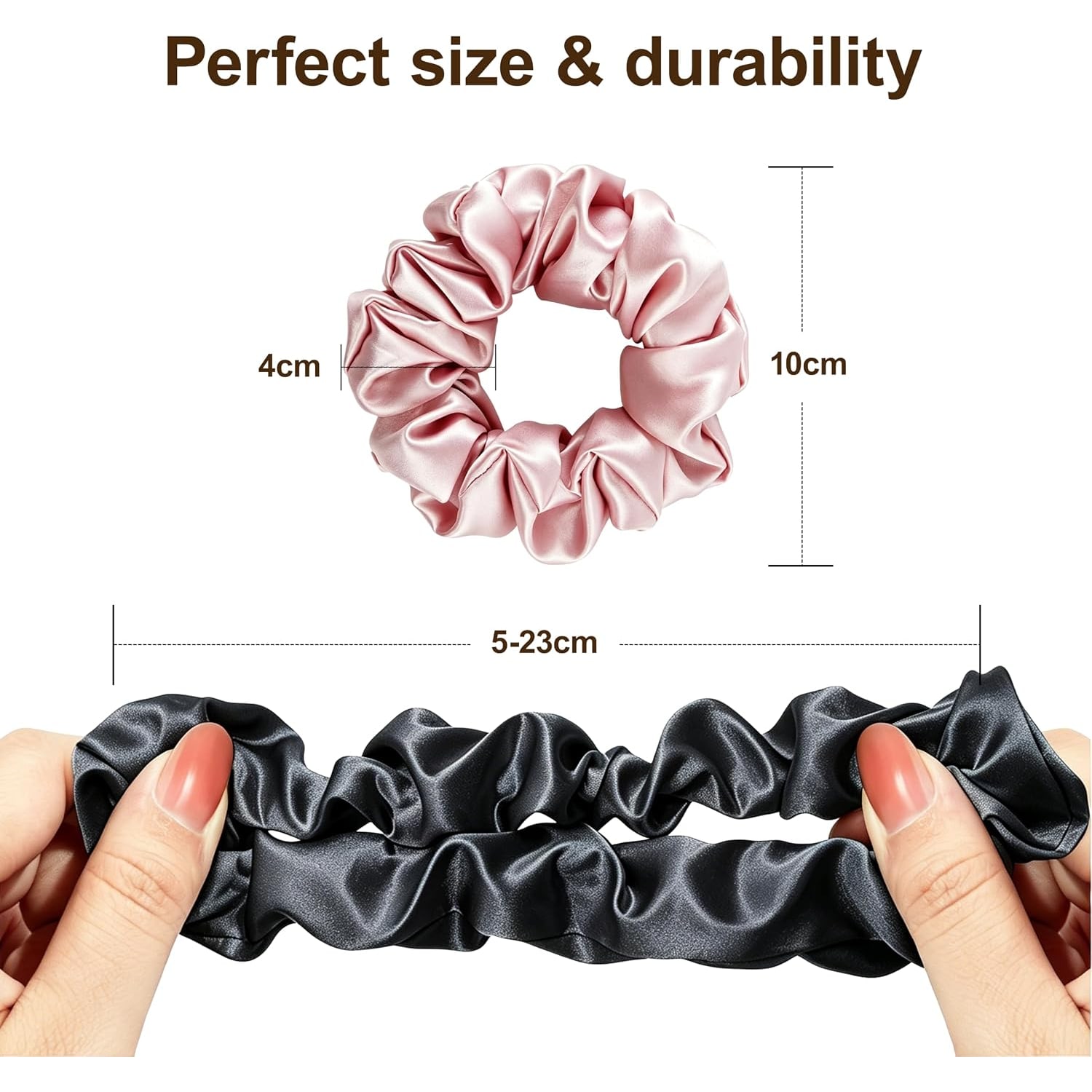
Both scrunchies in this pack are large. That is not padding, it is a functional choice.
Think about what happens when you tie thick hair with a small scrunchie. You have to wind it three or four times to get any hold. Each wrap stretches the elastic further, the fabric bunches into a tight knot, and the pressure concentrates on a small patch of the ponytail. That is exactly the situation that produces a crease and a sore spot.
A larger gather means more fabric, more circumference and fewer wraps. Two turns instead of four. The band sits wider on the hair, so the same holding force spreads over more surface. It is more comfortable and it is kinder to the elastic, which is usually the first part of any scrunchie to give up.
If your hair is fine or short, a large scrunchie still works. It will just read as an accessory rather than a fastening, sitting visibly at the base of a ponytail. Some people want that. Others prefer something discreet, in which case a smaller size is the better pick.
For buns, large wins almost every time. Wrapping a twisted bun needs circumference, and a small tie fights you.
The two colours, and why a pair is useful
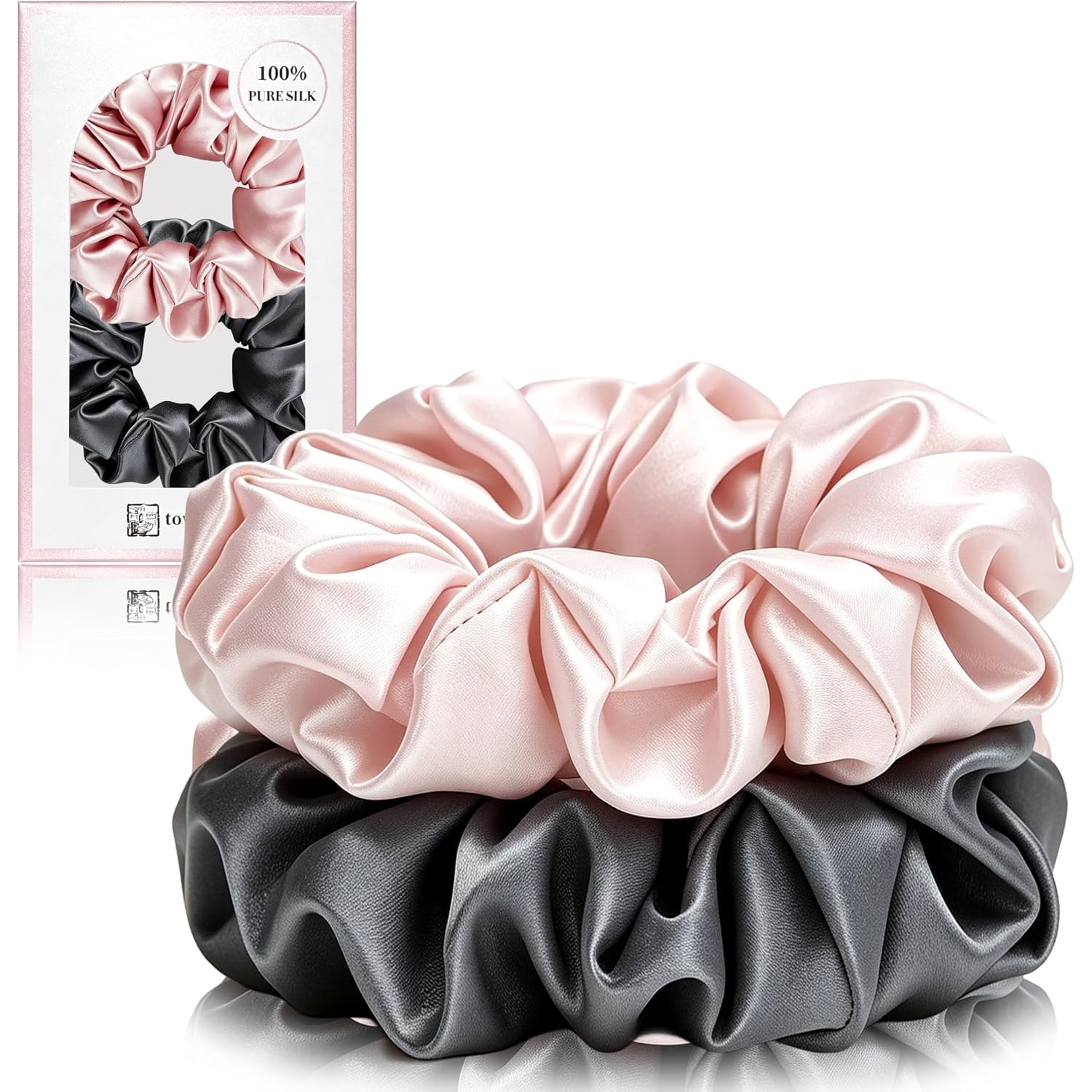
Dark grey and pink is a sensible combination. Grey is the quiet one. It sits with a work outfit, a dark coat or a grey jumper without drawing a line of attention across the back of your head. Pink is the warmer choice, better for a casual day, and the one most people reach for in summer or when they want the accessory to show.
The practical argument for a two-pack is simpler than the style one. One is always in the wash, in a coat pocket, or somewhere on the floor of the car. Having a second means you are never caught out. Buying two colours rather than two of the same also means you can match the mood of the day rather than the single colour you happened to order.
Looking after them
Silk is not fragile, but it does have preferences. Three things damage it quickly: heat, bleach and hard scrubbing.
Wash by hand in cool water with a mild detergent made for delicates or wool. Swirl the scrunchie around for a minute, give it a gentle squeeze, then rinse until the water runs clear. Do not wring it out. Twisting silk stresses the fibres and distorts the gather. Press the water out inside a folded towel instead, reshape the scrunchie with your fingers and leave it flat to dry somewhere out of direct sun.
Skip the tumble dryer entirely. Heat is bad for the silk and worse for the elastic. A warm radiator is no better. Air drying takes a couple of hours and costs nothing.
If you use a lot of hairspray, dry shampoo or oils, wash more often. Product residue builds up on the fabric and dulls the surface over time. Once a week is a reasonable rhythm for daily wear.
A few small habits extend the life of any silk hair tie. File rough nails, take rings off before you tie your hair up, and avoid velcro. Do not leave a scrunchie stretched around your wrist all day if you can help it, because constant tension tires the elastic faster than normal use does.
Who these suit
People with thick or long hair get the most obvious benefit, because the large size solves a real problem for them. Anyone who wears a bun regularly will also notice the difference, since a bun needs circumference more than it needs grip.
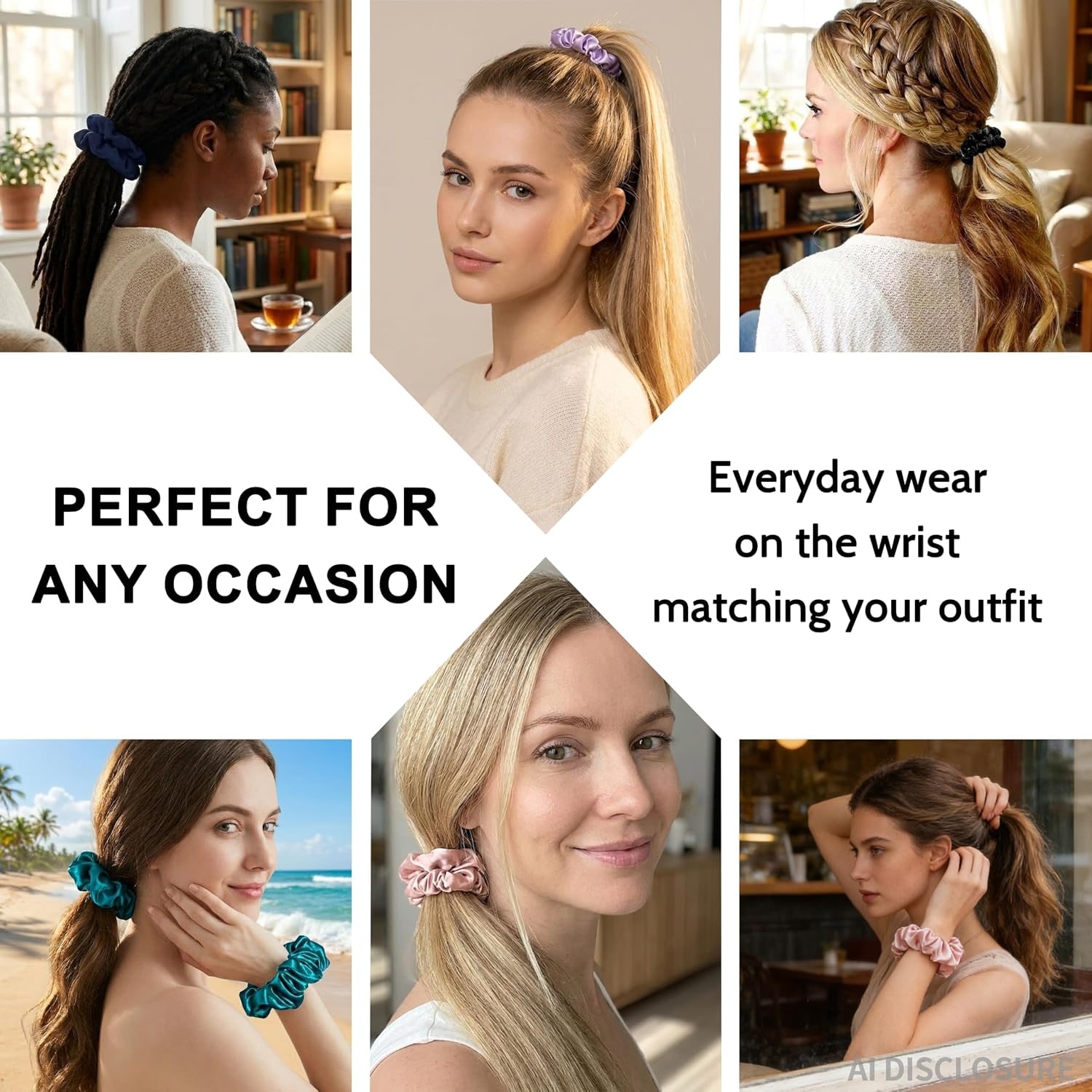
They also work well for overnight wear. A loose bun or plait held with a large silk scrunchie is easier to sleep in than anything tight, and the soft band does not press into the scalp the way a thin elastic does.
If you have very short or very fine hair and want something invisible, this is probably the wrong size for you. And if you need a tie that holds a tight, high, gymnastic-grade ponytail that will not shift for three hours, a sport-specific elastic is the more honest answer. Silk scrunchies are about comfort and finish, not maximum grip.
The short version
Two large scrunchies, both covered in 100% mulberry silk at 22 momme, one in dark grey and one in pink. The 22 momme weight means a dense fabric with body rather than something thin and shiny. The large size means fewer wraps around thick hair and less pressure in one spot. Hand wash cool, dry flat, keep away from heat.
Finished dimensions, item weight and country of origin are not specified for this pack, so if an exact measurement matters to you, ask before ordering. Everything else is straightforward. It is a small upgrade to something you use every day, which is usually where small upgrades pay off best.