
The complete guide
How To Choose Silk Scrunchies That You Will Actually Wear
The problem with most hair ties
Most people own a drawer of hair ties they do not like. There are the thin elastics that snap, the fabric-covered ones that have gone slack, and the chunky scrunchie bought on impulse that turned out to be too big for a normal day. Somewhere in there is one good tie, and that one gets used until it dies.
The reason this happens is that hair ties are usually bought without much thought. They are small, they are cheap, and they get grabbed at the till. But a hair tie is the thing that sits on your head for ten hours at a stretch. The surface it is made from, the width of the band and the tension of the elastic all affect how your hair looks at the end of the day and how easy the tie is to remove.
A silk-covered scrunchie addresses the surface part of that. The elastic that does the gripping sits inside a fabric tube, so what touches your hair is woven silk rather than rubber or a rough synthetic. It is not complicated. It is just better contact.
What mulberry silk actually is
Silk comes from the cocoon of the silkworm. Mulberry silk is the kind produced by silkworms raised on mulberry leaves, and it is the most widely used type for clothing and bedding because the filaments are long, fine and consistent. Long filaments mean fewer joins in the yarn, and fewer joins mean a smoother surface.
That smoothness is the whole appeal. Run your finger along a mulberry silk band and then along a cotton one and the difference is immediate. Hair behaves the same way. It slides over silk rather than gripping it, which is why pulling a silk scrunchie out at the end of the day tends to be an easy motion rather than a tug.
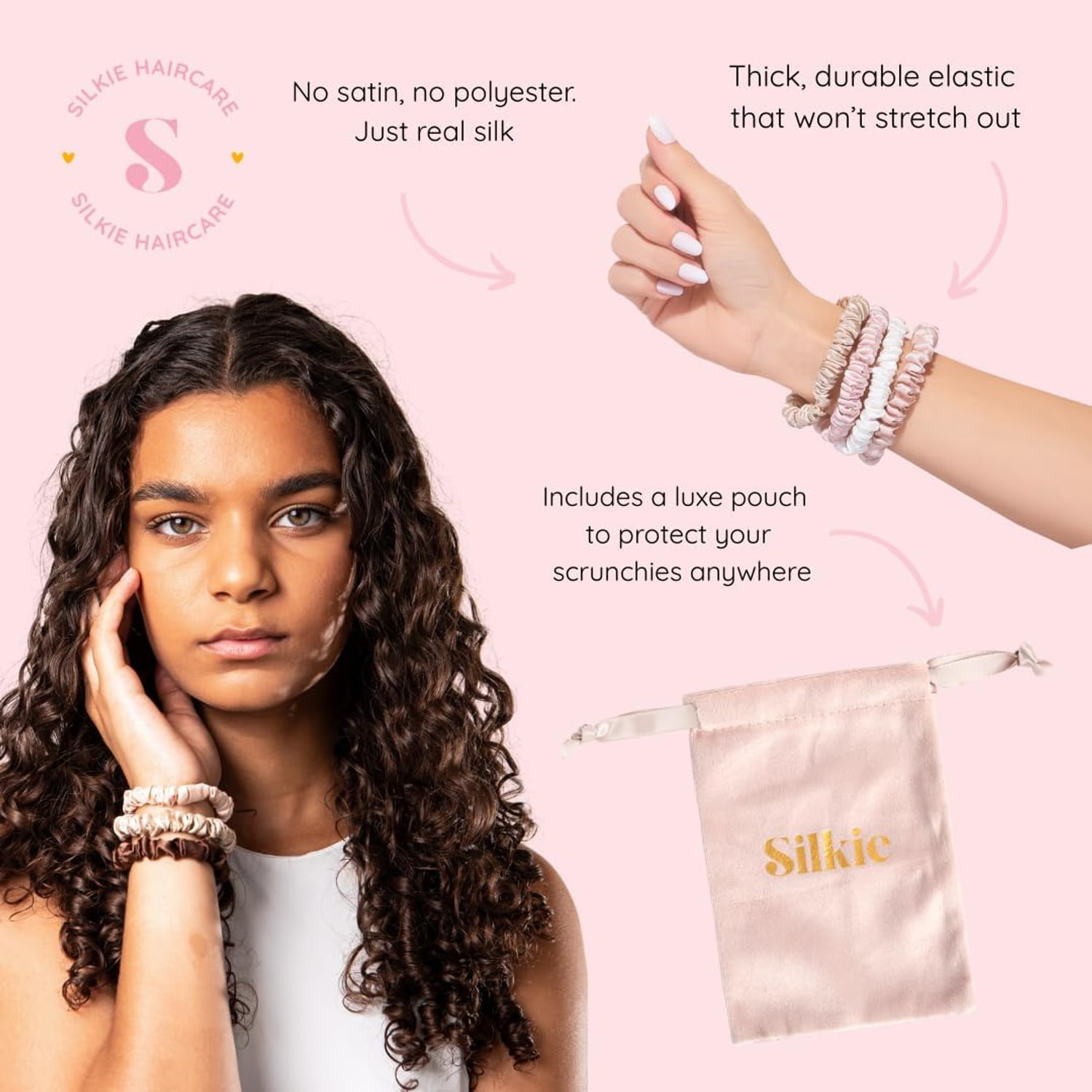
In this set, the silk is the outer fabric. The elastic lives inside, hidden, doing the work. That is the standard construction for a quality silk scrunchie and it is what you are paying for.
Why skinny instead of chunky
Scrunchie width changes everything about how the accessory reads. A wide, heavily gathered scrunchie is a visible accessory. It sits as a cloud of fabric at the back of the head, it announces itself, and it works well when you want it to be part of the outfit.
A skinny scrunchie does the opposite. The band is narrow, so it wraps tight to the hair and the ponytail stays the main event. It slips under a hood, a hat or a coat collar without creating a lump. It also wraps more times around a thinner ponytail, which gives a more secure hold on fine hair than a bulky band that only gets one loop in before it runs out of stretch.
If you have tried scrunchies before and found them too much, this is the shape to come back to. The best skinny silk scrunchies give you the smooth surface without the volume.
Who this set suits
Anyone who ties their hair back most days will get use out of four matching ties. People with fine or medium hair tend to get on best with a skinny band, because the narrower profile wraps enough times to hold without slipping. People with very thick hair may prefer a wider style with more stretch, or may simply use two of these at once.
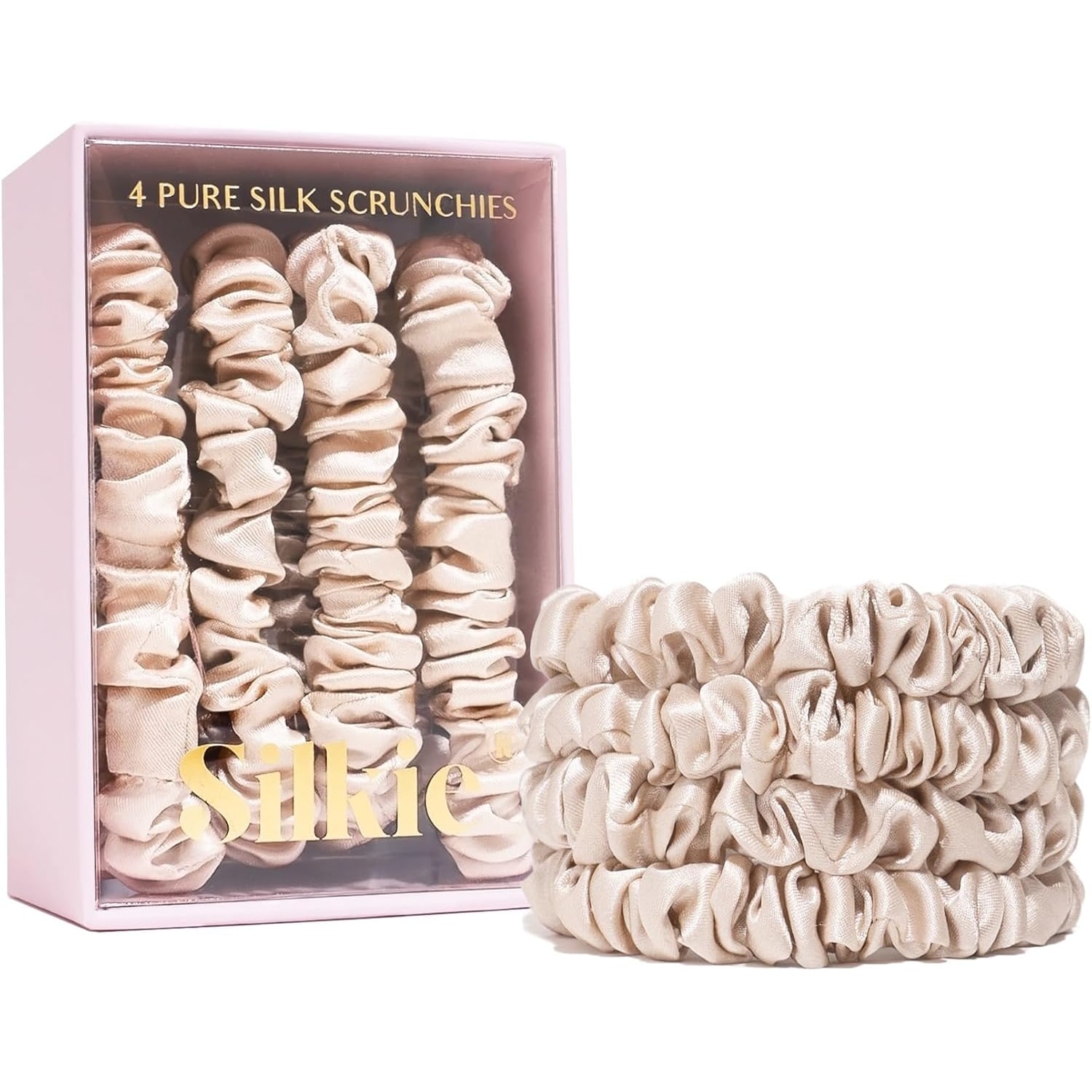
The champagne colour is a soft, warm neutral. On light and mid-tone hair it blends almost completely. On dark hair it shows as a gentle contrast, in the way a cream ribbon would. If you want a tie that vanishes into black hair, this is not that tie, but if you like a small visible accent it works nicely.
It is also a practical gift. Four matching pieces in a pouch, in a neutral colour, suits almost anyone who has long enough hair to tie back. That is why matching sets turn up so often on lists of the best silk scrunchie gift set ideas.
How to choose between scrunchie sets
Start with width, because that is the decision that changes the look. Skinny for everyday and understated, wide for presence and for very thick hair.
Then think about colour. A neutral like champagne goes with everything and will be the one you reach for without thinking. Brights and prints are fun but tend to sit in the drawer waiting for the right outfit. If this is your first silk set, neutral is the safer buy.
Next, piece count. A single scrunchie sounds economical until you lose it. Four is a sensible number because it covers the bathroom, the bag, the gym kit and the drawer, and rotating between them means each elastic gets a break. Elastic lasts longer when it is not stretched every single day.
Last, check the construction. You want silk on the outside and the elastic fully enclosed. An exposed elastic edge defeats the purpose, because that is the part that catches.
Getting the most out of them
Put the scrunchie on with your hand flat rather than hooking a single finger through it and yanking. Finger-hooking is what stretches the elastic unevenly and what pulls threads in the silk if you have a rough nail or a ring with a claw setting.
Do not pull the ponytail tighter than you need. A hair tie that is doing its job holds the hair in place, not under tension. Over-tightening is hard on both your hair and the elastic.
Rotate through all four rather than using one until it gives up. A rested elastic recovers some of its shape, and four scrunchies used in turn will last considerably longer than one used constantly.
Washing and storage
Hand washing is the straightforward option. Cool water, a small amount of detergent made for delicates, a gentle swirl, then a rinse. Do not scrub and do not wring. Press the water out between the folds of a towel and lay the scrunchie flat to dry somewhere out of direct sun. A radiator or a hot windowsill will dry it faster and age the fabric faster too.
Skip the bleach and skip the tumble dryer. Heat is the enemy of both silk and elastic. If a crease bothers you, a quick press on the lowest silk setting with the iron kept moving will sort it, though most creases relax out as the scrunchie is worn.
For storage, use the pouch. It keeps the four together, keeps them away from keys and zips, and means you can find one in the dark at the bottom of a bag. Hair ties have a talent for disappearing, and a pouch is the cheapest fix for that.
How often you wash depends on your routine. If you use styling products, dry shampoo or you train regularly, every week or two is sensible. If the scrunchie only sees clean hair in the evening, you can stretch it longer.
A note on expectations
Silk is a natural fibre and it behaves like one. It is smooth and it is light, but it is not armour. It can catch on a sharp edge, it does not like bleach, and the dye will fade if you leave it baking in sunlight. Handled with a little care, it holds up well and keeps that soft hand for a long time.
The elastic inside is the part with the shorter life. That is true of every scrunchie ever made, regardless of what the shell is. Buying a set of four rather than a single tie is the simplest way to stretch out the useful life of the whole pack.
The short version
This is a set of four skinny scrunchies in champagne, each wrapped in 100% mulberry silk fabric over an elastic core, supplied in a small travel pouch. The slim shape keeps a ponytail neat and sits flat under a hood or a hat. The silk surface is smooth, so hair slides over it rather than catching, which makes the tie easy to remove.
Choose this set if you have fine to medium hair, you tie your hair back most days, and you want something understated that still feels like an upgrade on a plain elastic. Wash it by hand in cool water, dry it flat, keep it in the pouch, and rotate through all four. That is really all there is to it.